itis-sumo
Headless surrogate-modeling core for design-space exploration
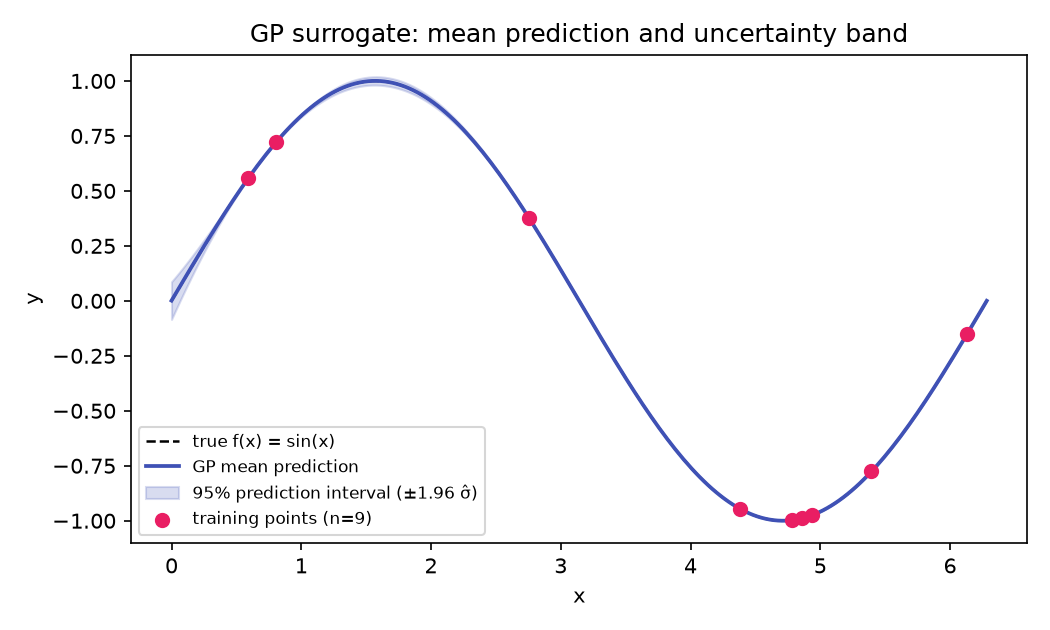
Running complex simulations across design spaces is slow and expensive. itis-sumo lets you train a fast surrogate model that captures the simulation's behavior — so you can sweep parameters, optimize designs, and quantify sensitivity with honest uncertainty bars.
Scope: itis-sumo is a headless computational core with no Flask, oSPARC,
or web-UI dependency. For the web UI, see the separate mmux_documentation
site.
What you can do
-
Train surrogates Build GP / polynomial surrogates on simulation data — in-process via the Dakota wheel, no shell-outs.
-
Quantify sensitivity Sobol' indices and UQ propagation with
scipy.stats, on top of your already-built surrogate. -
Cross-validate Rigorous surrogate evaluation with explicit-seed sampling and honest error metrics (RMSE, R²).
-
Multi-objective optimization Find Pareto fronts with MOGA without leaving the Python API.
-
Preprocess Normalize / rename training variables before fit and inverse-transform after, via
DataPreprocessor. -
Worked examples Real Dakota fits validated against closed-form analytical solutions, with figures.
Verification & Validation: the full pipeline is verified against known analytical solutions — available on request: current report.